|
I've always had a bit of a wry sense of humour, and a somewhat cynical view of the world. I was worried that I had lost my sense of humour, along with my rather dirty laugh, after Tim died. They both did come back, but my sense of humour is now somewhat darker.
Dark humour is a coping mechanism. It's a distraction and a way of accepting the situation. It can also be used to bring people in the same situation together – I've seen it in doctors, nurses, ambulance crew and police. I have used dark humour about my sexuality when telling other queer people and allies about experiences of biphobia. An incident in a local pub: "You are marrying a woman? But you used to be married to a man, and he's dead? Your husband knew you liked women? Did you sleep with women while you were married to your husband?" I have also used dark humour to tell other widows about dealing with muggles (people who haven't been bereaved). A woman rang up, wanting to talk to Tim, who used to be a bookseller. She launched into a stream of explanation about books she wanted to sell. I finally managed to break in to explain that he had died. She paused imperceptibly and then asked me if I still wanted to buy the books. I said that I wasn't involved in the shop and she rang off. About five minutes later, the same woman, the same explanation. I broke in, this time to say, "You've already spoken to me and he's still dead." She responded to say, "I didn't – I dialled another number…" and I put the phone down. Comedians and writers who have used humour to handle widowhood include Kat Lister, Tawny Platis (founder of Death is Hilarious) and Sandra E Manning. It's important to remember that dark humour can be disconcerting for people outside of the community that you are in. I made a dark widow humour comment on a Zoom writing workshop about one bonus of his death being that I could finally get rid of his grandmother's coffee tables, and there was a moment of dead air followed by some nervous laughter.
0 Comments
I've known that I was attracted to both men and women since my 20s. Actually… the crushes on a couple of truly awesome female teachers in my teens might mean I knew it before, but didn't realise what it meant. The first time I came out as bi to a lesbian friend, she told me that bisexuality is just a phase, and I should pick a side. Consequently, I didn't tell anyone else for a long time.
I married Paul at 24, which now seems impossibly young. Over a decade our marriage fell apart. Tim, who I'd known for many years, helped me through depression and a divorce, and we drifted from being very close friends to falling in love. While I spent this period of my life 'straight passing', I was still bisexual. Tim knew about my sexuality and loved me all the same. He died suddenly at 50, after we'd only been married nine years, and my life crumbled. Some friends had known that I was bi, but I wasn't really out. Even before Tim died I'd been feeling that I was somehow living a lie, and betraying who I was. As I started to build another life, I became more open about what I was. And when I started seeing a woman, I couldn't really hide any more. The responses to me coming out, as well as 'picking a side', ranged from total acceptance and 'when I met you, my gaydar pinged, but I assumed that I was wrong – I see now', to 'I don't understand – you used to be married to a man but he's dead' and 'does that mean you were sleeping with women when you were married to your husband?' Now I am married to a woman, I guess I'm 'lesbian passing', and I suspect that many people think I have made a major lifestyle change, finally picked a team, or only just realised I'm gay. This isn't helped by bi erasure, and by the media and entertainment tropes about bisexuals showing them (us) as cheating, confused, greedy, promiscuous, villainous, unable to stay faithful, or just bi-curious. And that's just the women. The bisexual men are much less visible. However – I am proudly and defiantly queer. I am bisexual, from the pink and purple in my hair down to my awesome Pride Converse. Have a wonderful Celebrate Bisexuality Day! #CelebrateBisexualityDay #BisexualPrideDay #BiVisibilityDay You are a widow* and are welcome here if you have lost your partner.
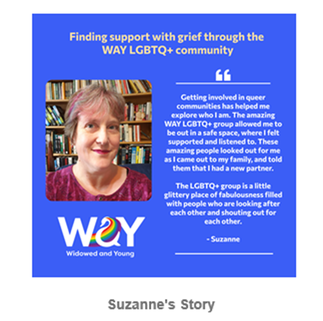
Young or old or somewhere in between – you are a widow. Committed to each other for a few months, or the whole of your life – you are a widow. Living together or living apart – you are a widow. Going through tough times when they died – you are a widow. Queer or straight – you are a widow. Cis, trans, non-binary, agender, gender-expansive, gender-fluid, intersex – you are a widow. Childless, child-free, have children or have lost children – you are a widow. In a traditional or a non-traditional relationship - you are a widow. Got another partner or are dating, or haven't got another partner, don't want another partner or don't want a traditional relationship – you are a widow. Days in or decades in – you are a widow. *I use 'widow' as a non-gendered term I've shared my story on the WAY Widowed and Young website. "I was widowed at 50 when Tim, who I expected would be my happy-ever-after following a marriage break-up, died suddenly from heart failure linked to his type 2 diabetes. Although we'd known each other since our early 20s, we’d been married less than ten years. I was fortunate to find WAY Widowed and Young and the subgroup WAYWOCs (Widowed and Young WithOut Children) just a few days after I was widowed. I can honestly say that I couldn't have got through the past four years without this incredible bunch of young widows, male and female, cis and trans, straight and queer. We have shared (virtually and face-to-face) our tragedies, our successes, our tears, our laughter, and any number of truly bad puns and Marmite-related comestibles. I’m bisexual, I’ve known since my 20s but been married and divorced and then married and widowed, each time to a man, had me hiding in plain sight. I’m now in a same-sex relationship with an amazing woman called Dee and we’re getting married in August. It’s important to me that I am a bisexual woman, and that I am still me, whoever I’m in a relationship with. Getting involved in queer communities has helped me explore who I am. The amazing WAY LGBTQ+ group allowed me to be out in a safe space, where I felt supported and listened to. These amazing people looked out for me as I came out to my family, and told them that I had a new partner. The LGBTQ+ group is a little glittery place of fabulousness filled with people who are looking after each other and shouting out for each other. We celebrate the good days and the successes, support each other through the bad days, make each other laugh, talk about frocks and lipstick and films, rant, and send each other virtual hugs. I have been fortunate that, apart from some rare occasions, I’ve seen nothing but acceptance. My family, friends and village have fully accepted my partner, which is fantastic. But I know that the WAY LGBTQ+ group would have been there for me if it hadn’t been like that." |
AuthorI was widowed at 50 when Tim, who I expected would be my happy-ever-after following a marriage break-up, died suddenly from heart failure linked to his type 2 diabetes. Though we'd known each other since our early 20s, we'd been married less than ten years. Archives
March 2026
Categories
All
|

RSS Feed